



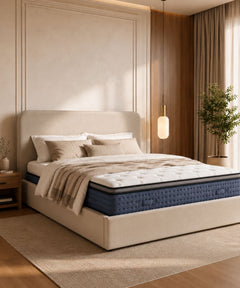






Choosing a mattress seems simple until you start comparing the technologies: foam, memory foam, latex, Bonnell coils, pocketed coils, hybrid mattresses, different densities, thicknesses, and firmness levels… Yet there is no single “best mattress” for everyone. The right choice depends on your body type, your sleeping position, your comfort preferences, your bed base, and sometimes even the type of bed the mattress will go on. Here are the main criteria to know so you can understand the differences between mattresses and choose the one that truly fits your needs.
What Are the Different Types of Mattresses?
The vast majority of mattresses sold today fall into four main families. These are foam mattresses, latex mattresses, Bonnell coil mattresses, and pocketed coil mattresses. There are also technologies that are less common for ordinary home use, such as waterbeds or certain air mattresses, but they account for a much smaller share of the mattress market. Each technology has its own advantages and drawbacks.
The Foam Mattress: Simple in Appearance, Highly Variable in Quality
Calling a mattress a “foam mattress” doesn’t really say much about its quality. Two foam mattresses can offer very different levels of comfort, support, and durability. It all depends on factors such as the type of foam used, its density, its thickness, the number of layers, whether it includes memory foam, and the addition of gel or other technical materials. The simplest models generally use a fairly basic foam, while more sophisticated mattresses combine several layers, each with a different function. A more technical foam can, for example, improve body support, distribute pressure, or add comfort without requiring an extremely thick mattress.
Memory Foam
Memory foam responds to the pressure and heat of the body, among other things. It gradually conforms to the sleeper’s shape and distributes pressure more evenly, particularly around the shoulders and hips. It is often used as a comfort layer, paired with a firmer support foam underneath. Some memory foams also include gel, which is meant to improve airflow and temperature regulation while you sleep.
The Latex Mattress: Elasticity and Support
Latex is prized for its elasticity and its ability to quickly spring back into shape. It can provide responsive support and good ventilation when it has many perforated zones. Quality varies widely, however, depending on the mattress’s composition, the proportion of natural or synthetic latex, its density, and its internal construction. As with foam, the word “latex” alone isn’t enough to judge the true quality of a mattress.
Bonnell Coil Mattresses: The Traditional Technology
Bonnell coils are one of the original technologies in innerspring mattresses. They are made of metal coils linked together. The system is sturdy and relatively simple, but when you press on one area of the mattress, the movement can travel more easily to the neighboring coils. For someone who sleeps alone, this can be perfectly acceptable. For a couple, however, that transfer of movement can become more noticeable during the night.
Pocketed Coils: Better Motion Isolation
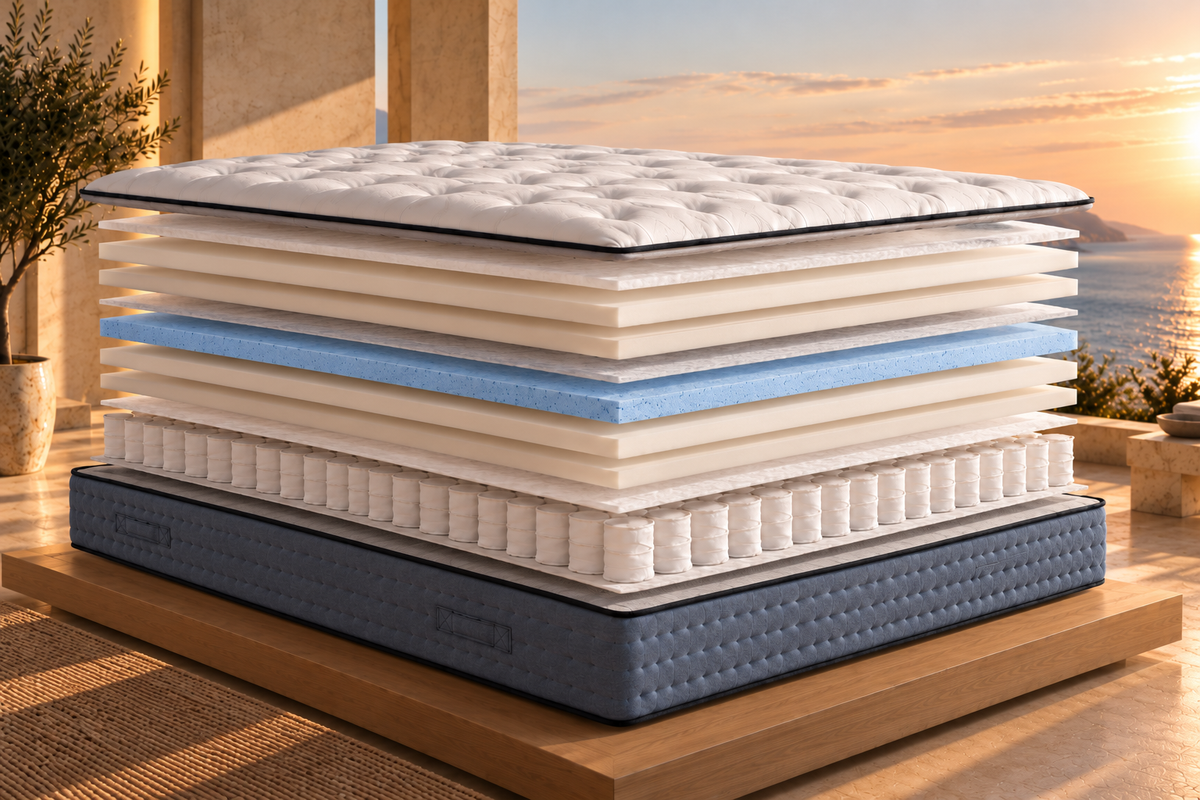
Pocketed coils work differently. Each coil is placed individually in a fabric pocket, so it can respond more independently to the pressure applied to the mattress. That is one of their biggest advantages. When one person changes position during the night, less of the movement reaches the other side of the bed. This is known as motion isolation. The technology also allows for more precise body support, since the characteristics of the coils can vary from one zone of the mattress to another. That is why SENHO chose pocketed coil technology for its THENEST and LASUITE mattresses, rather than traditional Bonnell coils.
Foam Mattress or Innerspring Mattress: Which Should You Choose?
There is no one-size-fits-all answer. A good foam mattress can be better than a bad innerspring mattress, and vice versa. Technology is only part of the equation. A foam mattress can be especially appealing if you want a relatively light mattress, a moderate thickness, progressive comfort, or a mattress for a bed with specific height restrictions. A pocketed coil mattress can be especially appealing if you share your bed, want good motion isolation, prefer responsive support, or enjoy the feel of a traditional high-end mattress. In both cases, you then need to look at what surrounds the core of the mattress: the quality and density of the foams, the comfort layers, the reinforced edges, the cover fabric, and the finishing details.
Does Foam Density Matter?
Yes, but it needs to be understood correctly. Foam density is generally expressed in kg/m³. It indicates how much material is used in a given volume of foam. Among other things, it affects the foam’s mechanical properties and its durability.
But density and firmness are not exactly the same thing. A dense foam is not necessarily extremely firm, and two foams with the same density can feel different depending on their composition. That is also why modern mattresses often combine several layers of different foams. Each layer then plays its own role: cushioning, support, pressure distribution, stability, or comfort.
What Firmness Should You Choose for Your Mattress?
The comfort you feel depends heavily on your body type and your sleeping habits. A mattress that is too soft can let some parts of the body sink in too far. A mattress that is too firm, on the other hand, can create pressure points, especially at the shoulders and hips. The goal is to support the body evenly enough while allowing the main pressure zones to sink in slightly.
If you sleep on your back, you generally want balanced support to keep your pelvis from sagging too much. If you sleep on your side, the surface needs to leave enough room for your shoulders and hips to limit pressure points. If you sleep on your stomach, a mattress that is too soft can let your pelvis sink in significantly, so firmer support is often the better choice. In reality, many people change positions regularly throughout the night. A balanced mattress often remains the most versatile choice.
Is Mattress Thickness a Sign of Quality?
Not necessarily. A thicker mattress is not automatically a better one. Its thickness depends mostly on how it is built. An innerspring mattress with several comfort layers will naturally be thicker than a foam mattress designed to deliver good support at a lower height. In some cases, excessive thickness can even become a problem. This is especially true for loft beds and elevated beds.
Which Mattress Should You Choose for a Loft Bed or an Elevated Bed?
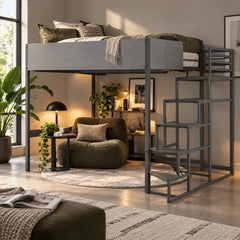
This is a point that is often overlooked when buying a mattress. On a loft bed or an elevated bed, the mattress needs to be more than just comfortable: its thickness must stay compatible with the actual height of the bed’s safety guardrail. The thicker the mattress, the smaller the distance between its surface and the top of the guardrail. A mattress that is far too thick can therefore reduce the protection the guardrail provides. It is essential to follow the bed manufacturer’s recommendations for maximum mattress thickness. That is exactly what SENHO developed the NIMBUS for.
NIMBUS: A 15 cm Mattress Designed Especially for Elevated Beds
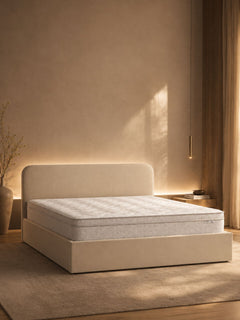
The SENHO NIMBUS takes a different approach from very thick mattresses. Its thickness of about 15 cm makes it particularly well suited to loft beds or elevated beds that require a sufficiently tall safety guardrail. But reducing thickness doesn’t mean sacrificing comfort. SENHO therefore focused on the quality of the foams and how they are combined. The NIMBUS pairs a support foam with a gel memory foam layer with a density of 38 kg/m³. This layer offers several benefits: gradual contouring to the body, reduced pressure points, ergonomic comfort, and better airflow thanks to the gel. The NIMBUS is therefore an appealing option if you want a relatively slim but technically sophisticated mattress, especially for an elevated bed.
THENEST: The Right Pocketed Coil Mattress with the Best Balance of Quality and Price
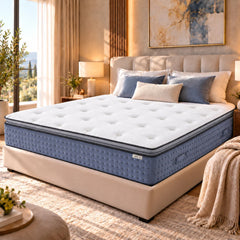
For THENEST, SENHO made a different choice: pocketed coils. The goal is a versatile mattress that offers good motion isolation and an excellent balance of comfort, support, and price. Around its pocketed coil core, THENEST uses several layers of comfort foam. Alternating foams with different characteristics, with densities ranging from 18 to 24 kg/m³, allows the mattress’s cushioning and support to be built up gradually. The goal is to avoid two extremes: a surface that feels too hard or, on the contrary, a feeling of sinking in too far.
The reinforced perimeter improves how well the mattress holds up along the sides. This is especially useful if you sleep near the edge of the bed or sit on it regularly. It also lets you make better use of the full width of the sleeping surface. THENEST is therefore SENHO’s choice for anyone looking for a good pocketed coil mattress with excellent value for the money.
LASUITE: The Experience of High-End Hotel Bedding
LASUITE sits at the top of the SENHO mattress range. Its goal is different: to recreate the generous, enveloping feel associated with good high-end hotel bedding. Its more sophisticated construction combines several complementary technologies. The core of the mattress is built on pocketed coils arranged in 3 zones, in a structure about 25 cm tall. These zones make it possible to tailor support to the main parts of the body, such as the shoulders, hips, and legs, while keeping a stable and durable core.
LASUITE pairs the coils with two layers of memory foam, one of which includes gel. These layers contour to the sleeper’s body, ease pressure points, and improve thermal comfort. Several comfort foams complete the build to create a progressive feel. Your body isn’t simply resting on a uniform block: the different layers come into play one after another to provide cushioning, support, and stability.
As with THENEST, the edges of the mattress are reinforced. This improves edge stability, maximizes the sleeping surface you can actually use, and helps the mattress hold up well over time. Finally, LASUITE has a bamboo-based cover, chosen for its softness and breathability. Together, these features create a plush mattress for people who want, above all, a premium sleep experience. LASUITE is therefore the top-of-the-line mattress in the SENHO collection, designed to bring the comfort of an excellent hotel bed into your own home.
NIMBUS, THENEST, or LASUITE: Three Mattresses for Three Different Needs
Rather than trying to make a single mattress that is supposed to suit everyone, SENHO developed three approaches. NIMBUS favors a moderate thickness and technical foams. It is particularly appealing for elevated beds and loft beds. THENEST favors value for the money, with pocketed coil construction, multi-layer foams, and reinforced edges. LASUITE takes comfort further, with 3-zone pocketed coils, several foam layers including two memory foam layers, a reinforced perimeter, and a finish designed for a high-end sleep experience. Still can’t decide between the three? Check out our dedicated guide, “Comparing NIMBUS, THENEST, and LASUITE: Which SENHO Mattress Should You Choose?”, where we compare their technologies, their thickness, and the type of sleeper each one is designed for in detail.
So, How Do You Choose Your Mattress?
Before you buy, don’t stop at thickness or at labels like “memory foam” or “coils.” Look at the construction of the mattress as a whole: its main technology, the quality and density of its foams, the type of coils used, its motion isolation, its cushioning and level of support, its thickness, the quality of its edges, its breathability, and above all its compatibility with your bed and the way you sleep. The best mattress is not necessarily the thickest or the most complex. It is the one whose construction truly matches the way you use it. And that is exactly the philosophy that guided SENHO in developing NIMBUS, THENEST, and LASUITE.



Leave a comment
This site is protected by hCaptcha and the hCaptcha Privacy Policy and Terms of Service apply.